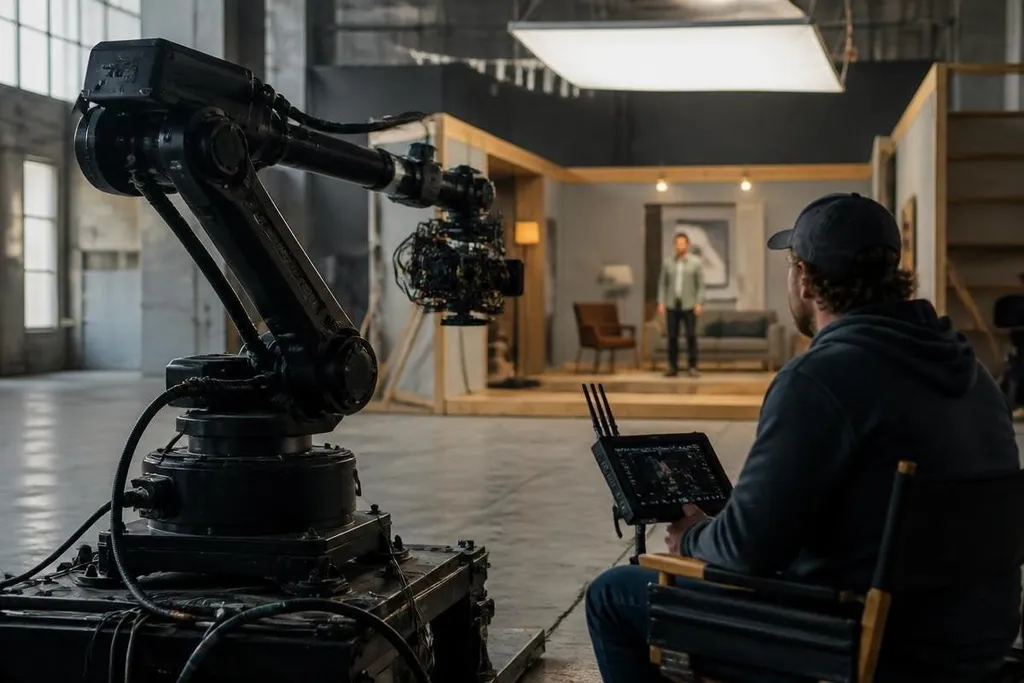
A film robot earns its place when it repeats the same camera move after the crew changes the set, light, or actor position. The next stage of robotic filmmaking will depend less on dramatic stunts and more on safe motion, accurate timing, and clear control.
For directors, camera operators, and production managers, the useful question is practical: can the robot save setup time without making the shot harder to manage?
Quick read
- Repeatable camera paths matter more than raw arm speed.
- Human-safe operation is needed on crowded sets.
- A robot still needs a crew member who can check framing and stop motion fast.
What film robots actually need to do
A film robot may carry a camera, move a light, control a dolly, or repeat a programmed path. Each task has a different load, reach, and safety risk, so one robot design will not fit every production.
Camera movement is the clearest test. The system needs to start, stop, and turn at the same points each time. Small timing errors can change focus, motion blur, or the actor’s position inside the frame.
That makes control software as important as the arm or vehicle. A path planner sets the route, sensors track the robot’s position, and an operator checks the result through a monitor.
If the robot uses simultaneous localization and mapping, or SLAM, it builds a map from sensor data while it moves. On a film set, the map must account for people, cables, stands, and objects that may move between takes.
Safety comes before speed
Film sets are crowded work areas. Actors, camera crews, lighting teams, and production staff may stand close to the robot, often while the robot carries equipment that adds weight and momentum.
A safe system needs a reachable emergency stop, clear movement limits, and a way to reduce speed near people. The crew also needs a marked operating area and a simple process for checking the path before each take.
This matters most when the robot works near an actor. A smooth camera move has little value if the crew cannot predict where the arm, cable, or platform will be during the shot. Slow, known movement is easier to manage than fast motion that needs constant correction.
That concern gives the crew a practical test: track the robot’s speed, path, operator input, and stops during a real shot. A dated Robot24.com report can place those details beside the camera move, so the next question is who keeps control when the scene changes.
The crew still controls the shot
Automation can repeat a path, but it cannot decide whether the actor’s expression, focus, or framing works for the scene. Those choices stay with the director, cinematographer, camera operator, and focus team.
The best control system should make changes easy. A crew member may need to adjust the camera height, slow one section of the move, or set a new end point after a rehearsal. If each change requires a specialist to rewrite code, the robot becomes another production delay.
A useful interface should let the operator record points, adjust speed, set limits, and return to a known position. The system should also save the move so the crew can repeat it later without rebuilding the path from the start.
That repeatability has value beyond one shot. A production may need the same camera move across several takes, pickups, or scenes. The robot can hold the path, but the crew must still check the set because scenery, props, and people change.
Where the limits remain
Film work rarely happens in a fixed space. A set can change between takes, and a location shoot may add uneven ground, rain, dust, tight access, or poor wireless coverage. These conditions can affect wheel traction, sensor readings, and operator control.
A robot also needs enough payload for the camera, lens, battery, mounting hardware, and any stabilizing equipment. More weight can reduce acceleration and increase stopping distance. That tradeoff puts a practical limit on how fast the robot should move.
The unproven part is the full production workflow. A robot may repeat one move well in a controlled test, but that does not show how it performs across long shooting days, changing locations, or frequent creative changes.
I'd choose a slower robot with clear limits over a faster system that makes the crew guess where it will stop.
A buying checklist for production teams
Before adding a film robot to a shoot, check these points:
- Camera load: include the camera, lens, battery, mount, and stabilizer.
- Movement record: confirm that operators can save and repeat paths.
- Human safety: test the stop button, speed limits, and marked work area.
- Set changes: check how fast the crew can adjust height, route, and timing.
- Power plan: measure battery time and the changeover process between takes.
The next useful film robot will be judged by a plain result: after the first take, can the crew change the shot, run it again, and know where the camera will be at every moment?